
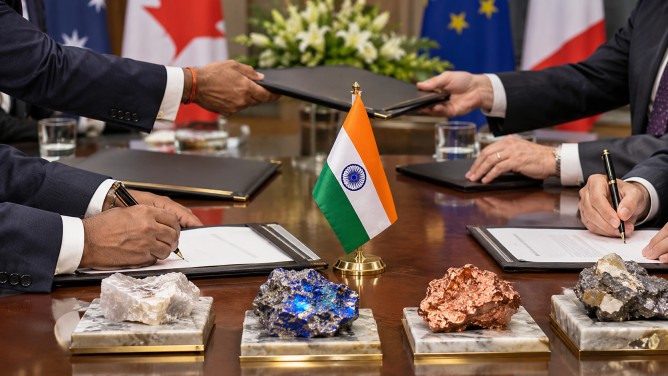
India has emerged as a leader in the global race to secure critical minerals, having signed 15 agreements since January 2025. These agreements aim to bolster the supply of essential materials like lithium, cobalt, nickel, graphite, copper, and rare earth elements, which are crucial for clean energy technologies such as electric vehicle batteries and wind turbines. This positions India ahead of China, Canada, Saudi Arabia, and the European Union, each with 11 agreements, though still trailing the United States, which has entered into 41 such agreements.
The initiative is part of India’s National Critical Mineral Mission, launched in January 2025 with a government allocation of Rs 16,300 crore and an additional Rs 18,000 crore expected from private investments. This mission seeks to reduce India’s dependence on foreign suppliers by enhancing domestic exploration, processing, manufacturing, and recycling capabilities. In pursuit of these goals, India has planned 1,200 domestic exploration projects and is securing overseas mining assets through both public and private enterprises.
Among the key international partnerships, state-owned Khanij Bidesh India Ltd has collaborated with Argentina’s CAMYEN to explore five lithium blocks, covering over 15,000 hectares. Furthermore, India is exploring joint investment opportunities in lithium and cobalt with Australia, while expanding its cooperation with Germany and Norway in the critical minerals sector.
As nations worldwide vie for these vital resources, the competition underscores the necessity for countries like India to not only secure raw materials but also develop robust domestic manufacturing capabilities. Building sustainable supply chains, generating employment, and enhancing industrial capacity are crucial for meeting the increasing global demand for clean energy technologies.
However, transparency concerns persist, as 39 percent of the critical minerals agreements analyzed lack publicly available texts. This highlights the need for greater openness in international resource agreements, even as countries strive to secure their energy futures.