
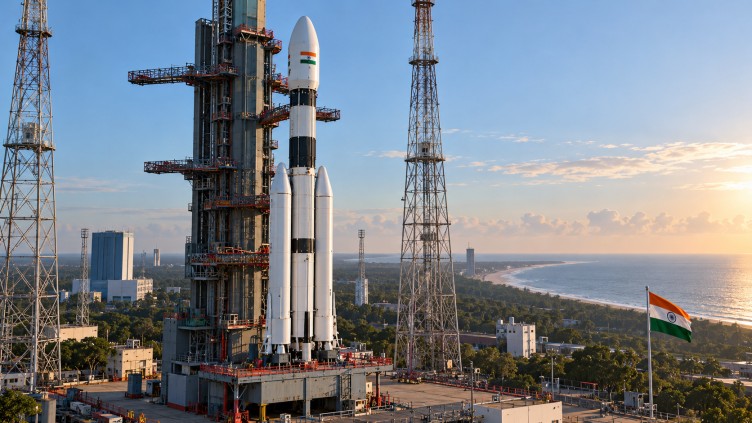
The Indian Space Research Organisation (ISRO) is set to enhance India’s satellite navigation capabilities with the launch of the NVS-03 navigation satellite on October 30 at 11:51 p.m. This mission, announced by ISRO Chairman V. Narayanan, aims to bolster services for transportation, civilian, and strategic applications by ensuring the continuity and expansion of India’s navigation infrastructure.
The NVS-03 satellite will be launched from the Second Launch Pad at the Satish Dhawan Space Centre in Sriharikota, aboard the GSLV-F18 rocket. This mission signifies the 20th flight of India’s Geosynchronous Satellite Launch Vehicle (GSLV), marking a significant step in the country’s space endeavors.
As the third satellite in India’s next-generation navigation satellite series, NVS-03 is designed to support and enhance the Indian Regional Navigation Satellite System (IRNSS), also known as NavIC. It introduces new capabilities including an indigenous atomic clock and the addition of the L1 navigation signal, enhancing the existing L5 and S-band signals. These advancements aim to improve the availability and reliability of positioning, navigation, and timing services.
India’s navigation system is engineered to cover the nation and extend services approximately 1,500 kilometers beyond its borders. This system has critical applications in real-time train tracking, vehicle monitoring, aircraft-related services, and navigation for maritime activities, alongside meeting strategic requirements.
According to Narayanan, the upcoming launch will play a crucial role in maintaining operational navigation services and fortifying India’s ability to deliver precise positioning and timing information. This mission represents a continued effort in expanding the country’s indigenous space-based navigation infrastructure, cementing India’s growing capabilities in space technology.